
 –
–
Below are 5 reasons that should more than tip the scales and help you pick a resolution that will benefit you for years to come.
1.- LED Light Lifespan:
The lifespan of LED lighting is easily the most significant advantage to switching, compared to traditional lighting solutions. The average LED lasts 50,000 operating hours to 100,000 operating hours and sometimes possibly more. That lifespan easily doubles if not quadruples most fluorescent, metal halide and sodium vapor light. A typical lifespan for an HID bulb, by comparison, is 10-25% as long at best (10,000 – 25,000 hours). A longer lifespan not only saves you money in replacement parts, i.e. lamps, but also in the sometimes overlooked cost of labor and maintenance required to monitor and re-lamp said equipment.
2.- LED Efficiency:
LEDs are renown for consuming very low amounts of power, which of course equals savings to the owner. In our experience most LED lighting retrofit projects result in a 60-75% improvement in the overall energy efficiency of the facility’s lighting.
3.- LEDs Eliminate Warm-Up Times:
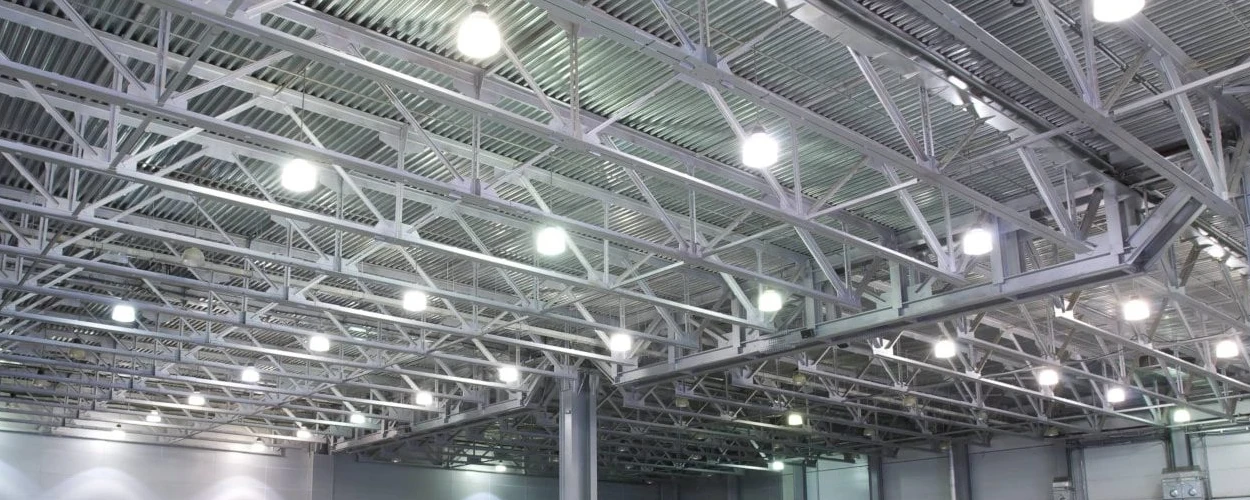
In the case of commercial lighting, such as warehouse facilities, metal halide lamps in particular are notorious for long warmup times (15-20 minutes is typical to get to full power). Long warm-up times not only prove to be an inconvenience to the tenant but also a needless energy consumption in order to cycle the lamps up to full power.
4.- LEDs Equal Better CRIs:
The Color Rendering Index (CRI) is a measurement of a light’s ability to reveal the true colors of an object as compared to natural light. Higher CRI scores are considered better, since it means that objects and fields of vision are viewable in a closer to ideal natural light setting. Comparing LEDs to traditional lighting solutions for commercial lighting is a night and day comparison. LED solutions easily rate in the 70 to 95 range (out of 100) on the CRI index, whereas HID commonly rate in the 65 to 70 range (out of 100).
5.- LEDs and Cold Temperatures:
LEDs love the cold unlike fluorescent lamps. As temperatures drop, higher voltage is required to start fluorescent lamps, and luminous flux (the perceived power or intensity of light) is decreased. By comparison, LED performance increases in lower temperatures making them much more suited for the environment.